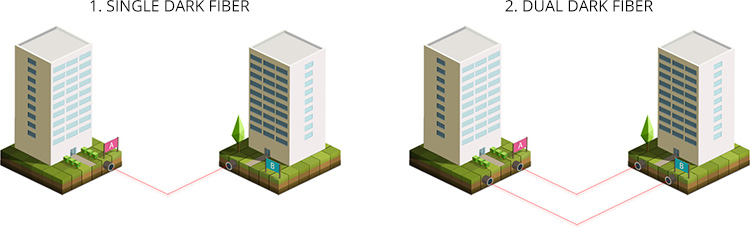
Dark Fiber refers to unused optical fiber that has been physically installed but carries no active light signal. The fiber is therefore literally “dark.” Organizations that lease or acquire Dark Fiber gain full control over the infrastructure: they decide which equipment, wavelengths, protocols, and speeds are used to light the fiber.
Dark Fiber enables ultra-fast, scalable, and highly reliable connectivity. This makes it popular among data centers, cloud providers, telecom operators, financial institutions, and enterprises with demanding performance and security requirements.
What Makes Dark Fiber Unique?
Full Control
Unlike lit fiber services—where the provider manages the optical equipment—the Dark Fiber customer determines exactly how the glass fiber is used. This includes:
- bandwidth/speed selection (1G, 10G, 40G, 100G, 400G+)
- DWDM technology to transmit dozens or hundreds of channels over a single fiber
- Layer-1 or higher-layer encryption
- custom monitoring and fault detection
This level of control makes Dark Fiber extremely flexible and future-proof.
High Capacity and Scalability
Since the customer manages the optical equipment, capacity can be increased without laying new physical fiber. A single Dark Fiber pair can be upgraded from 10G to 100G or even 400G simply by upgrading hardware at both ends.
Enhanced Security
Dark Fiber is a dedicated point-to-point physical connection. No other customers share the same path, which minimizes the risk of interception. Combined with optical encryption, it provides a highly secure network, ideal for sectors with strict compliance or data privacy requirements.
Low Latency
Traffic travels directly from point A to point B without intermediate provider switches or routers. As a result:
- fewer hops
- lower switching delays
- predictable latency
This makes Dark Fiber suitable for high-frequency trading, AI clusters, and data center interconnects.
Redundancy Options
Because Dark Fiber is physical infrastructure, organizations can deploy redundant links with fully diverse routes. This offers strong protection against:
- excavation damage
- regional outages
- backbone failures
Route diversity is a key factor in design and SLA agreements.
How Is Dark Fiber Delivered?
1. Annual Lease (Leased Fiber)
The customer rents one or more fiber paths from the provider.
2. IRU (Indefeasible Right of Use)
A long-term (typically 20–30 years) right to use specific fibers. It includes a one-time upfront fee plus annual maintenance. This is the closest option to “owning” fiber.
3. Self-Build
Large enterprises and municipalities may choose to install their own fiber infrastructure, often in cooperation with construction or utility partners.
Typical Use Cases
- Data center interconnect (DCI)
- Private cloud connectivity (AWS/Azure/GCP)
- Telecom and 5G backhaul
- High-capacity enterprise networks
- AI and HPC cluster connectivity
- Redundant WAN architectures across geographic regions
Conclusion
Dark Fiber is a powerful solution for organizations that need full control, maximum capacity, and high security. It combines the robustness of optical fiber with the freedom to build a custom network architecture without the limitations typically found in provider-managed services.