Many organizations are heavily investing in cloud strategies, AI initiatives, and cybersecurity.
But there is one fundamental part of the digital infrastructure that is still often underestimated: the network.
And that is exactly where one of the most significant transformations is currently taking place.
The reality of modern connectivity
Ten years ago, network architecture was relatively simple.
A headquarters, a few branch offices, and one or two data centers. Connectivity was delivered via MPLS or a fixed internet connection. Predictable, stable, and relatively easy to manage.
Today, that reality has completely changed.
Organizations now operate in a world of hybrid connectivity. In addition to fiber, there is increasing adoption of Fixed Wireless Access, such as Starlink and 5G, combined with cloud platforms, edge locations, and international sites that must all stay continuously connected.
The network has evolved from a static infrastructure layer into a dynamic ecosystem of connections.
And that is exactly where the challenge begins.
Many network architectures are still designed for yesterday’s world. They assume predictability, fixed paths, and limited variation in connectivity, while today’s reality is defined by constant change, fluctuations, and a growing number of dependencies. New connections are added, but the underlying architecture does not fundamentally adapt, causing complexity to accumulate over time.
The result is a network that grows, but does not evolve. A landscape where every new technology introduces additional management, more tools, and greater dependency, instead of flexibility and control. This creates a gap between what organizations need and what their network is actually capable of delivering.
The fundamental limitation of traditional networks
In many organizations, the network is still managed as a collection of separate components. Routers, firewalls, SD-WAN solutions, monitoring tools, and telecom portals all operate alongside each other, each with their own interface, configuration, and logic.
This leads to fragmentation. Visibility is limited, troubleshooting becomes complex, and organizations become dependent on specific vendors and technologies.
But the biggest limitation lies deeper.
Connectivity is still treated as infrastructure, while in reality it has become a critical resource that directly impacts performance, user experience, and business continuity.
WAN virtualization: the next step
What cloud computing did for servers and storage is now happening to networks.
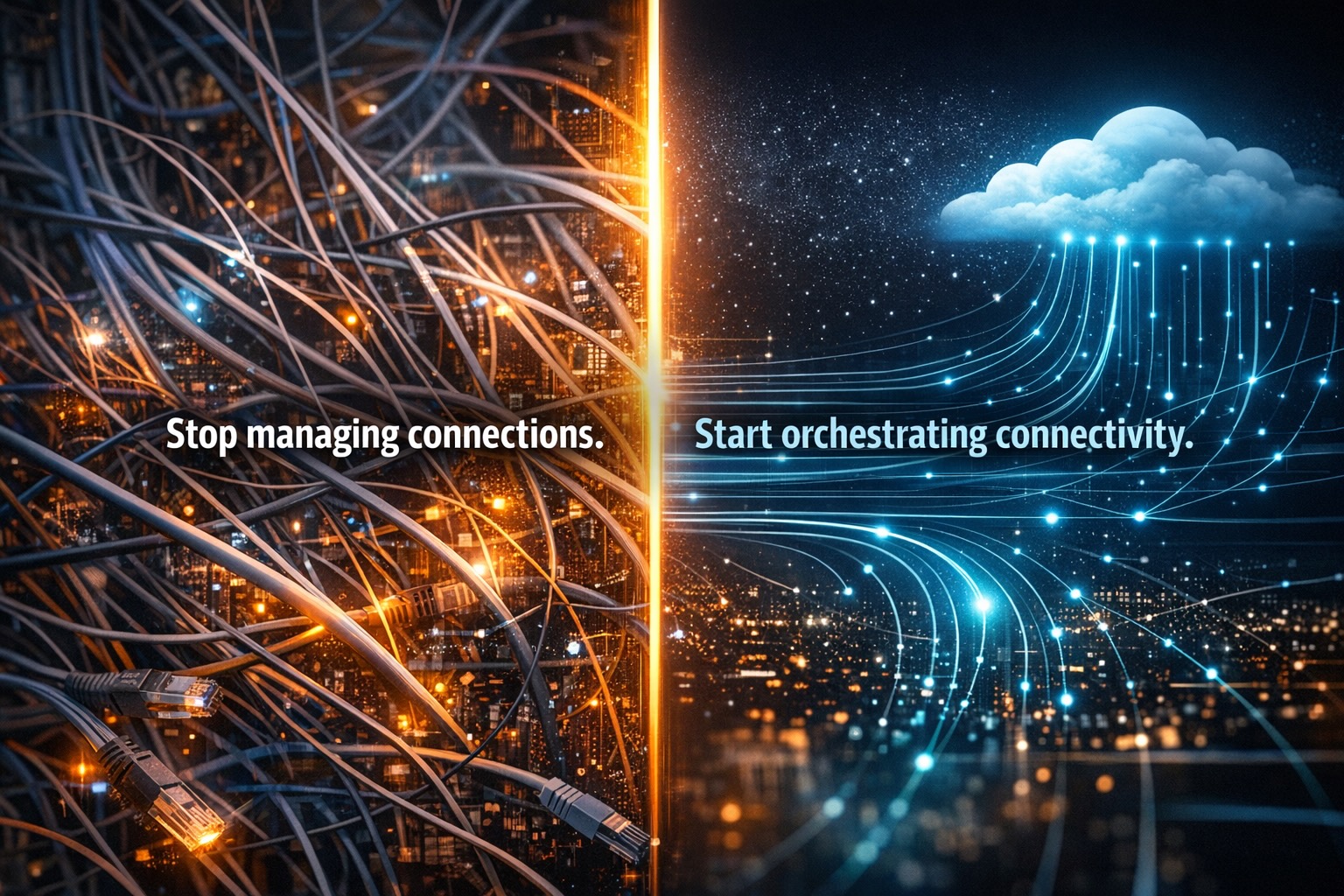
WAN virtualization introduces a fundamentally different approach. Instead of managing individual connections, organizations create a virtual connectivity layer that operates independently from the underlying infrastructure.
The question shifts from:
“Which connection does this location use?”
to:
“What connectivity does this application or user need right now?”
The network becomes programmable. Intelligence moves from hardware to software, and decisions are made based on real-time conditions instead of static configurations.
Why this moment matters
The acceleration of WAN virtualization is driven by several key developments.
New forms of connectivity, such as 5G, Starlink, and Fixed Wireless Access, make it possible to deploy connections faster and more flexibly. At the same time, they increase complexity, as organizations must manage multiple network types with different characteristics.
We also see the rise of multi-location organizations. In sectors such as education, healthcare, retail, logistics, and construction, reliable connectivity is essential to daily operations. Any disruption has immediate impact.
At the same time, geopolitical factors are becoming increasingly important. Organizations are asking critical questions about dependency, flexibility, and control. Network architecture is no longer just a technical decision, it is a strategic one.
From network management to network operations
One of the most important shifts is that networks are evolving from a management environment into an operational platform.
Where the focus used to be on configuration and maintenance, it is now about real-time insight, automation, policy-based routing, and observability. Historical analysis and predictive capabilities are becoming essential to optimize performance and prevent disruptions.
The network is no longer a passive transport layer, but an active part of the digital operation.
The network as a strategic infrastructure layer
Many organizations have already virtualized their compute and storage.
The next logical step is the virtualization of the WAN.
WAN virtualization enables organizations to operate independently from specific providers, dynamically switch between connections, and deploy new locations faster. At the same time, it provides full control over traffic flows and performance.
In other words: the network becomes a strategic resource.
The role of Wanscale
At Wanscale, we don’t see WAN virtualization as a trend, but as a necessary evolution.
Our platform combines WAN virtualization with carrier independence, real-time observability, and intelligent routing. We help organizations transform their network from a complex infrastructure into a flexible, programmable connectivity platform.
A foundation ready for cloud, AI, edge computing, and everything that comes next.
Conclusion
The cloud fundamentally changed how we think about IT infrastructure.
The same transformation is now happening in the network.
Not because it is a hype, but because the reality of modern connectivity demands it.
Organizations that dare to redesign their network architecture today will build an infrastructure that is more flexible, more resilient, and more future-proof than ever before.
And it all starts with one simple question:
Are you still managing connections or are you managing connectivity?
Jos Beckers