The Tour de France is underway and every day, millions of cycling fans follow the battle for the yellow jersey. All eyes are on riders such as Tadej Pogačar, Jonas Vingegaard, Remco Evenepoel and Mathieu van der Poel. On television we see the legendary climbs, the sprint finishes and the tactical battles unfolding in the peloton.
But behind every stage, another race is taking place. Not only on the road, but also inside the team bus and the team car.
From team bus to race
Long before the riders roll onto the start line, the race has already begun.
Inside the team bus, the day’s strategy is discussed in detail. The route is analysed, dangerous sections are identified, potential crosswind areas, climbs, descents, feeding zones and key moments of the stage are reviewed.
Who will save energy? Who needs to be at the front at a specific moment? Where are the opportunities to put pressure on the competition? And when should the team control the race instead of attacking?
This preparation forms the foundation for the day. But once the race starts, the plan constantly evolves as race situations, weather conditions, attacks from competitors and unexpected events unfold.
From that moment onwards, the team car becomes the true command centre of the race.
The real command centre
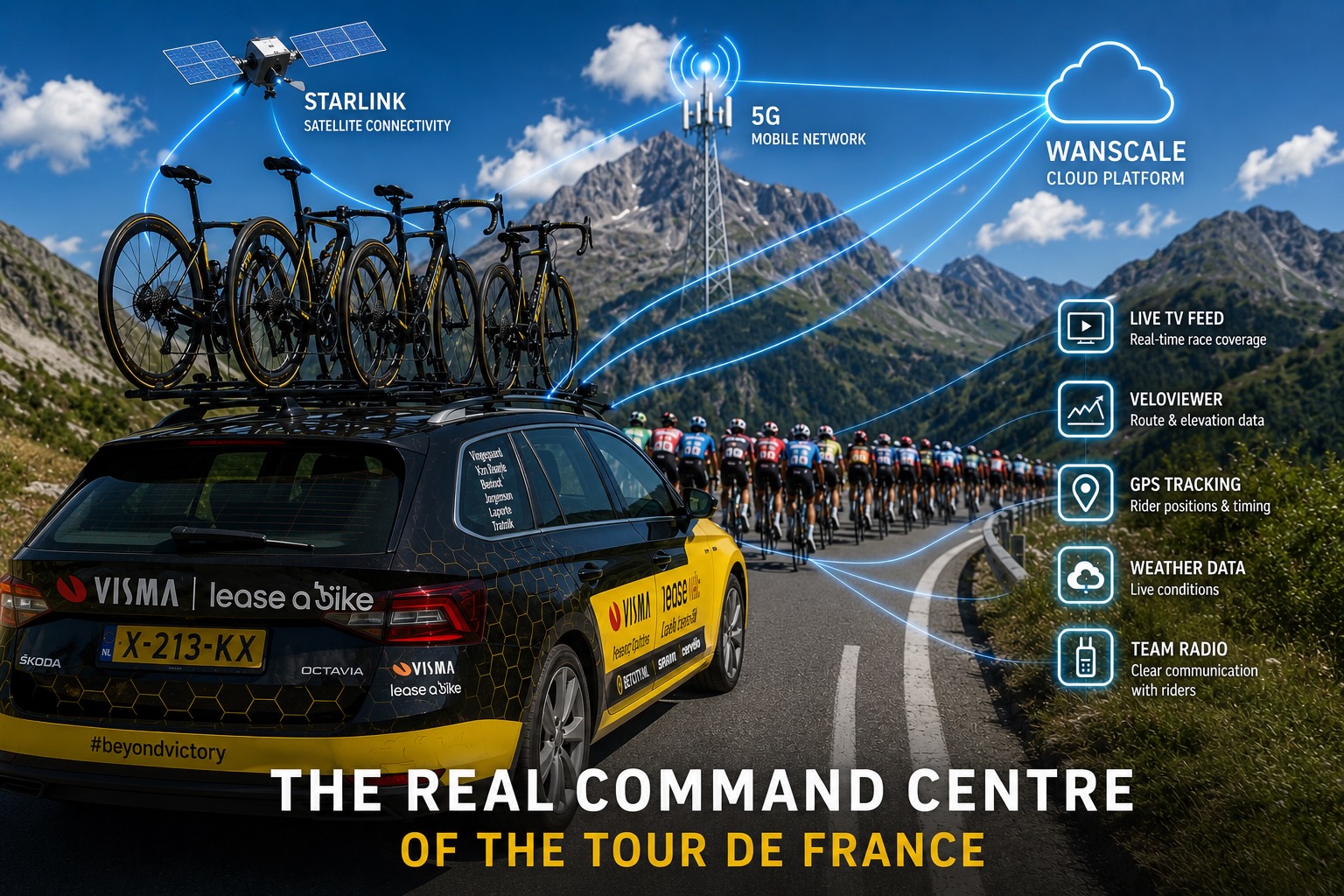
To most spectators, a team car is simply another vehicle following the peloton. In reality, it is a highly sophisticated mobile command centre where every critical information stream comes together.
While the Sports Director navigates through the race convoy, live television feeds are monitored, route information is consulted, weather conditions are analysed and race situations are continuously evaluated.
Through applications such as VeloViewer, the team management has detailed information about climbs, descents, technical sections and other decisive moments of the stage. At the same time, communication from race officials is monitored through the traditional Radio Tour system, while the Sports Directors remain in constant contact with the riders via team radio.
Performance data, rider locations and other race information are continuously analysed to support tactical decision-making.
Within seconds, all of these information streams must be translated into decisions that can determine the outcome of the race.
Connectivity has become a competitive advantage
The Tour de France takes the peloton through busy cities, open countryside, remote valleys and some of Europe’s highest mountain passes.
That creates a significant technical challenge.
Every system inside the team car must continue operating regardless of location. Live television, route information, communication with riders and access to critical applications must always remain available.
A lost connection or delayed video stream at the wrong moment can mean missing information that could influence an important tactical decision.
Reliable connectivity has therefore become an essential success factor in modern professional cycling.
Everything happens behind the scenes
For the public, the Tour began with Stage One.
For us, it started weeks earlier.
Together with BroadbandEU and Bridge4IP, the engineers at Wanscale prepared the complete communication environment inside the Visma | Lease a Bike team cars for three weeks of world-class racing.
BroadbandEU provides the Starlink satellite connectivity, Bridge4IP delivers the mobile 5G connectivity, and Wanscale acts as the intelligent platform that brings every available connection together into one reliable communication environment.
Every team car was extensively tested before travelling to France. Once the Tour begins, there is no room for surprises.
Everything simply has to work.
Technology you don’t see
Many cycling fans will have noticed the Starlink antenna mounted on the team cars.
What is less visible is the technology operating behind it.
By intelligently combining satellite connectivity, mobile networks and advanced networking software, the team management remains continuously connected, even when conditions change or individual networks experience reduced performance.
For the Sports Directors, that means one thing: always having access to the information needed to make the right decision at exactly the right moment.
Behind every attack Is a team
When Jonas Vingegaard launches an attack, when a teammate positions him perfectly before a decisive climb or when the decision is made to chase, or not chase, a breakaway, it may appear to be an instinctive choice.
In reality, every decision is supported by careful preparation, continuous communication and real-time information.
The Tour de France is still won by the strongest rider.
But behind every victory stands a team of specialists relying on technology, data and communication.
While millions of fans enjoy the racing, Wanscale, BroadbandEU and Bridge4IP work behind the scenes to ensure that Visma | Lease a Bike can rely on one of the most important success factors in modern professional cycling: reliable connectivity.
Jos Beckers