On invitation of Team Visma–Lease a Bike, I attended Gent-Wevelgem yesterday, nowadays also referred to as Flanders Fields.
Along the course, you still see the same familiar scene: riders battling the wind, the peloton splitting, attacks on the Kemmelberg, riders bouncing over the gravel sections of the Plugstreets, the tension of perfect timing. It looks like the pure essence of cycling.
But that image is misleading.
The real race is no longer decided solely on the road.
Behind every attack, every decision, and every position lies a layer of data, technology and real-time communication that has become decisive for success. What used to be a sport driven by instinct and experience has evolved into a system where information and timing make the difference.
I am a true cycling enthusiast, but I also have a professional bias when it comes to connectivity. During a race, I don’t just watch the riders, I focus on everything around them.
And that is exactly where you see how fundamentally cycling has changed.
Technology as a decisive factor
This shift is visible everywhere: technology is no longer supportive — it has become a decisive factor.
Nutrition and metabolism
Riders follow highly optimized nutrition plans, supported by real-time glucose monitoring and personalized strategies.
Training and Artificial Intelligence
Training data is continuously analyzed using AI models that predict and optimize workload, recovery, and performance.
Wearables and sensors
Power meters, heart rate monitors, cadence sensors, sleep tracking, and even temperature and hydration sensors generate a constant stream of data.
GPS and positioning
Teams know exactly where riders are, how fast they are going, and how the race is unfolding.
Video analysis and tactics
Footage is used to analyze race situations and refine strategies.
Equipment innovation
Disc brakes, aerodynamic helmets, optimized frames, thinner tires with lower rolling resistance, and clothing designed to reduce drag.
Wind tunnel analysis
Everything is tested — from rider position to helmet to bottle placement.
What all these developments have in common is one thing: data. Data that must be collected, analyzed and, most importantly, shared.
The invisible factor: connectivity
And that is where a new reality emerges, one that is often overlooked.
All this data, insight, and decision-making only has value if it is available at the right moment. In a sport where seconds matter, communication is critical. Not only between rider and team car, but also between vehicles, analysts, and support staff.
In practice, this means:
Live data from the bike must be instantly available in the team car
Decisions must be made and communicated in real time
Video and race data must be shared without delay
All of this… within a moving peloton, often in remote or mountainous areas
This is not a simple IT environment.
It is a moving, dynamic network.
The role of Wanscale in modern cycling
At Team Visma–Lease a Bike, this is where everything comes together.
Our role at Wanscale is not to make riders faster or optimize training schedules, but to do something more fundamental: ensure communication always works.
Together with BroadbandEU, we deliver a solution where multiple technologies converge:
Starlink connectivity for satellite coverage, even in remote areas
5G networks for low latency and high speed where available
Optimized antenna setups on vehicles
The Wanscale Service Edge, bringing everything together and optimizing performance
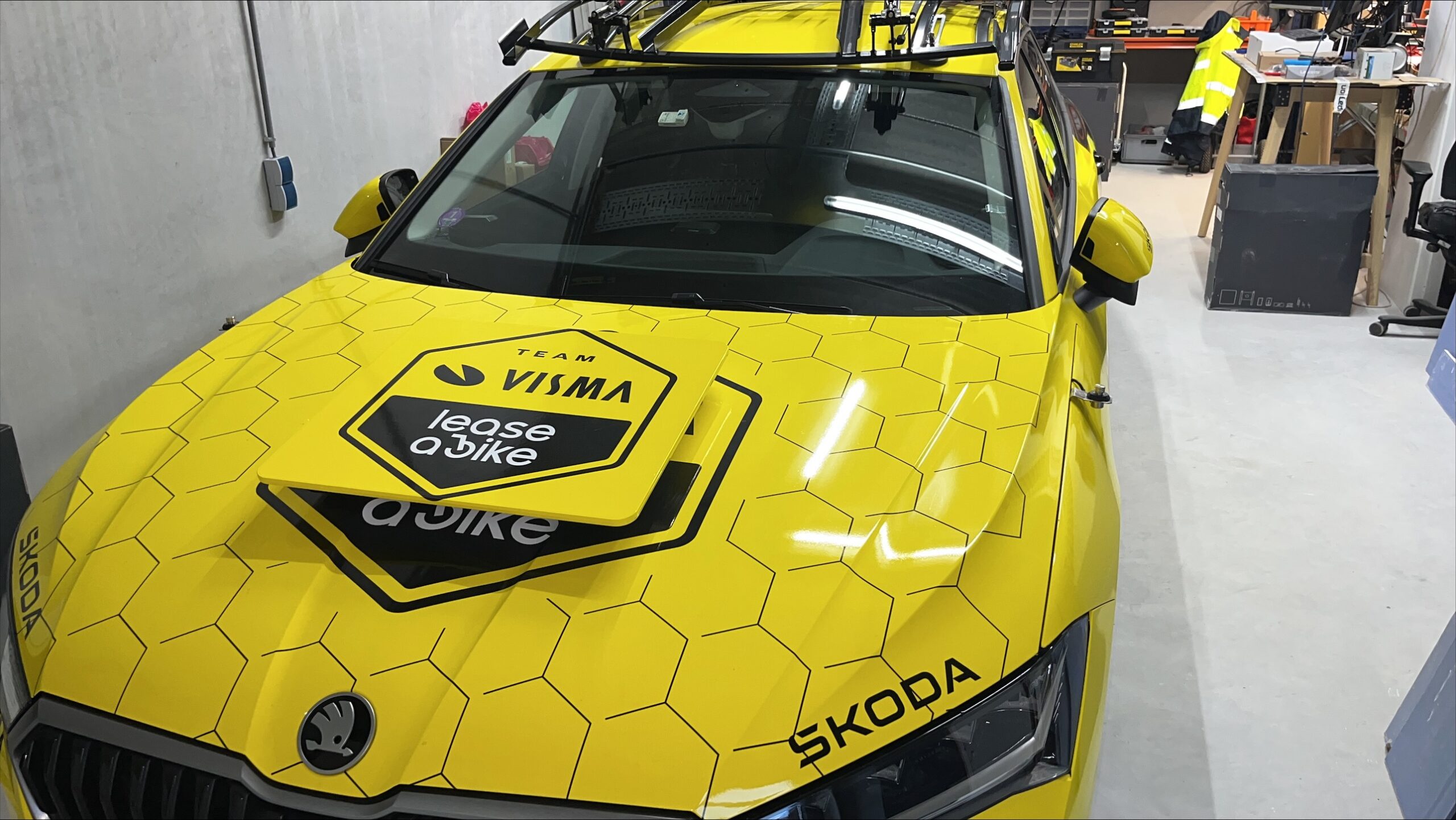
A small but telling detail: while Starlink antennas are often mounted on top of vehicles, we chose to place them on the hood of the team car. This allows us to use a higher-quality antenna, and to ensure visual integration, the antenna is wrapped in the same colors as the vehicle.
These are exactly the kinds of decisions, based on measurement, testing, and experience, that make the difference.
Connectivity as a silent force
What is happening here reflects a broader development: cycling has not only evolved physically and tactically, but has also become digitally mature.
And just like nutrition, equipment, and training, the real gains are not found in a single breakthrough, but in the intelligent combination of many small improvements.
Connectivity is the silent force behind it all.
You don’t see it, you don’t hear it, but without it, everything stops.
The technological revolution in cycling is far from over.
The race is still ridden on the road, but increasingly, it is decided beyond the view of the peloton.
Jos Beckers