Services
Bonding
Organizations combine fiber, 5G and satellite to increase availability and flexibility. However, in practice a new challenge arises: capacity and performance remain dependent on individual connections.
Available bandwidth is not fully utilized, and applications remain sensitive to variations in latency, jitter and packet loss.
Bonding within the Wanscale platform fundamentally changes this.
What is Bonding
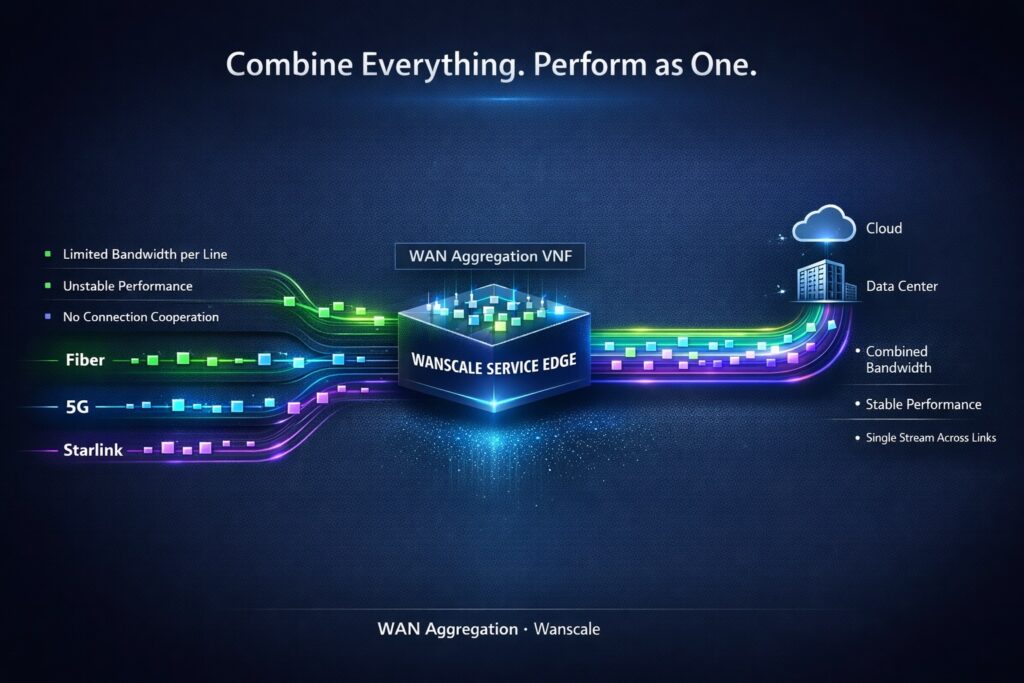
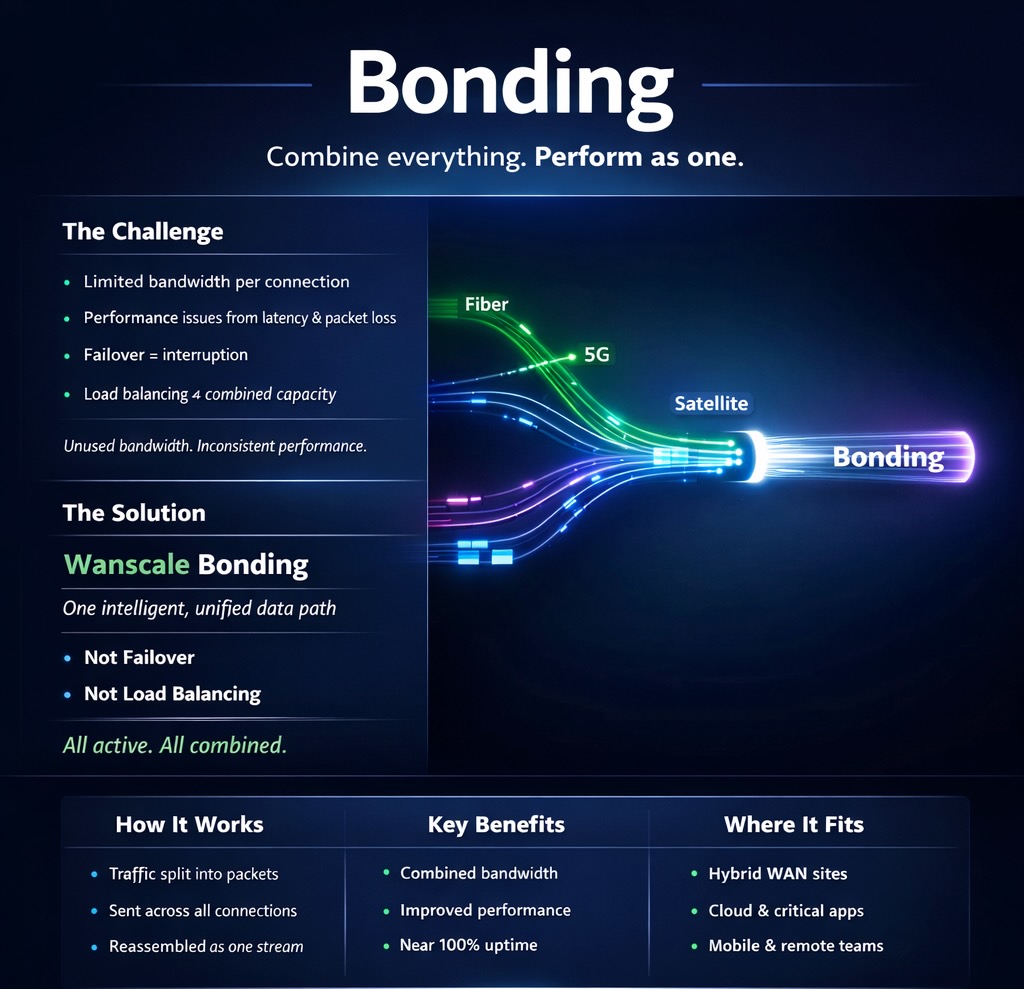
Bonding combines multiple WAN connections into one logical and intelligent transport path.
Not as failover. Not as load balancing.
But as a single integrated data stream that simultaneously utilizes all available connections.
This means that even single-stream traffic, such as a video call or file transfer, can benefit from the total combined capacity.
Why traditional solutions fall short
Failover
With failover, only one connection is active. In case of failure, traffic switches to another connection, which always results in interruption.
Load balancing
Load balancing distributes traffic across multiple connections, but individual data streams remain tied to a single connection.
Capacity is distributed, not combined.
How Bonding works
Bonding is activated within the Wanscale Service Edge as a Virtual Network Function (VNF).
The process:
- Traffic is split into data packets
- Packets are distributed across all available connections
- Real-time measurements continuously determine the optimal distribution
- At the receiving side, packets are reassembled
All fully automated and integrated within the platform.
What Bonding delivers
- Combined bandwidth across all connections
- Stable performance, even in variable network conditions
- Improved user experience for real-time applications
- Reduced impact of packet loss and jitter
- Very high availability
Typical use cases
Bonding delivers maximum value in:
- Hybrid WAN environments (fiber + FWA)
- Locations with variable connectivity
- Temporary or mobile locations
- Cloud-first organizations
- Critical applications such as VoIP, video and SaaS
Integrated within the Wanscale Service Edge
Bonding is not a standalone solution, but a fully integrated capability within the Wanscale platform.
It works seamlessly with:
- Telemetry Based Routing
- Firewall and security policies
- VNET routing and cloud connectivity
This allows bonding to be deployed without changes to existing configurations.
Technical deep dive
For advanced use cases, Bonding provides:
- Multipath transport across multiple WAN connections
- Overlay tunnels per connection towards the Aggregation Gateway
- Dynamic packet scheduling based on real-time metrics
- Packet resequencing and jitter buffering
- Optional forward error correction (FEC)
This results in a robust and adaptive transport mechanism that continuously adjusts to network conditions.
Clear benefits
- Multiple connections are used simultaneously
- All available bandwidth is combined
- Performance is determined by the whole, not by a single connection

Frequently Asked Questions about Bonding
Bonding ensures that the total bandwidth of multiple connections is truly combined, significantly increasing available capacity. This results in more stable network performance, even when individual connections vary in quality. By intelligently distributing and reassembling traffic, the impact of packet loss and jitter is greatly reduced, which is especially noticeable for real-time applications such as VoIP and video. At the same time, bonding significantly improves network availability, as multiple connections are active simultaneously and continuously complement each other, without the complexity of traditional solutions.
Interesse of meer weten?
Laat een bericht achter via onderstaand formulier en wij nemen zo snel mogelijk contact met u op.
Wanscale
Wanscale B.V.
Trivium 76
4873 LP Etten-Leur
088-1223400
info@wanscale.com